

There is a ballad that tells the story of two sisters who loved the same young man. One day the eldest sister pushed the other into the river. The sister’s body floated down the river until a bard found her and made her bones into a harp. The man traveled with this harp until he found himself in the court of the dead girl’s father. And as he set down his harp by the great fire in front of the entire court, the harp began to sing alone and tell the story of her sister’s betrayal. 
The ballad is all very romantic of course, but in real life it seemed rather morbid, to take someone’s body and make a musical instrument out of it (though it doesn’t seem to faze the bard in the song). Though harps are not usually made from bones, harp strings are another story.
I did some research this week to find out how harp stings are made. Some of them are made from nylon, and some of them are wire wrapped with a steel core. And some of them, it turns out, are made from real sheep gut. I touch my harp strings made of sheep gut every day without feeling the faintest quiver of revulsion.
But if you handed me a sheep and said, “There you go, here are your harp strings for the year,” I might balk. Almost as much as I did at the music shop last week when the clerk told me the total price for a replacement octave of strings.
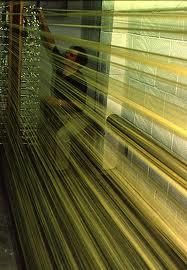 Maybe I shouldn’t be so squeamish; maybe it would in fact be more economical to raise my own sheep then to buy gut strings. If forced to choose between never hearing the harp again and making my own gut strings, I would probably make the strings.
But I am a child of the 20th century: if I had to choose between paying the $500 a new set of gut strings costs and making my own, I would certainly choose to pay the $500. And if I were sitting by the river one afternoon and the body of a beautiful woman washed up on the shore, I would not decide to make a harp out of her. Even if that harp would be able to play all on its own.
For a fascinating look at how modern gut strings are made, check out this video from the leading gut producer in the world Bow Brand of England.
It turns out that real people have been making instruments out of bones for centuries: flutes made from femurs and percussion instruments from skulls. How would you feel about the idea of being made into a musical instrument someday?
If you enjoyed this post, you might enjoy reading about the ballad itself: Binnorie, O Binnorie: A Tale of Murder and Magic.
Twin-Cities harpist Stephanie Claussen invites audiences to explore new locales and eras through her music. Influenced by her love of fairy tales, J.R.R. Tolkien, and the world music section at her local library, she performs a unique mixture of Scottish tunes, J.S. Bach, and anything rich in medieval or French harmonies. Sign up for her e-mail newsletter to receive important announcements and notifications of upcoming performances.
4 comments
eschminke
That is indeed a really interesting thought. I, for one, would think it the COOLEST thing to be made into an instrument someday. It would almost me like making your soul and voice immortal–as long as the instrument existed, anyway. Cemeteries are nice and all with the green park-like atmosphere and flowers… urns are nice decorative features in homes… but an instrument of your ancestors that can still “speak” and have function after death… now THATS really something to think about! Hmmm… come to think of it, maybe I’ll put that in my will.
Stephanie Claussen
Do you think your relatives (or whoever is in charge of executing your will) would be up for it?
eschminke
I dunno! They might be kinda weirded out by it– but hey– what kind of person would you be to deny a deceased woman’s wish?
Practicing for Heaven
[…] Next post: What’s in a String? […]