

Beginnings
About ten years ago, I sat playing my harp under a tree at the MN Renaissance Festival. My father stood nearby, talking with various passers-by. As I finished up a tune and considered what to play next, a man in Renaissance garb approached. “Would you mind if I play along?” he inquired, holding up a recorder.
“Oh,” I said. “I don’t know. What piece are you thinking of?”
“Do something you know and I’ll play along,” he said with a shrug.
And so I did, and the resulting music was lovely! Over my subsequent years of performing at the Minnesota Renaissance festival, the man with the recorder ceased to be “that one guy” and became Chris Mortika, an improvement to any piece of music and a friend.
Two years ago he found me and my father out at Festival and pitched an idea for an early music ensemble that performs actual period music, incorporates both instruments and voices, and appeals to modern ears. (As in, has a chance of keeping an audience in a place where said audience also has the option of watching jugglers throw flaming knives at each other, or speak for a half-hour in spoonerisms.)
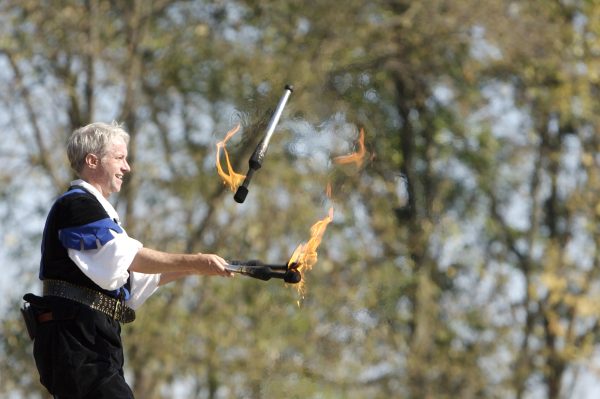
Photo by Tatton Partington
I said, “I like the idea, but I have too much going on right now and playing solo harp generates a whole lot more income than playing in a group.”
The following year changed some of my ideas.
Haley Hewitt came to town to judge the MN Scottish Harp Competition and between events we chatted about her life as a professional harpist. Inspiration oozed out of her. Back in Boston she collaborates with artists, percussionists, and other musicians; when I asked her why she collaborates so often when solo playing is more profitable, she replied simply that it helps her continue to hone her skills. I started thinking: maybe a group isn’t such a bad investment. Later on that year I spoke with my father’s violin teacher, Gary Schulte, whom I admire greatly. He plays professionally with many, many ensembles and is a superb musician. He commented that “one can learn a lot from being in a group.”
Last fall, Chris called me up. We got dinner and again he presented this idea of a mixed instrumental/vocal group that played excellent, entertaining, and accurate Renaissance music. I thought about my schedule. I thought about how hectic performing at the Renaissance Festival can be. I thought about my goals as a musician. Tentatively I said “Yes.”
Enter three lovely ladies
The group has been rehearsing since September. Our group consists of Chris, me, Kerry, Erin, and Kathleen. Collectively we play harp, cello, recorder (sop, alto, tenor and bass), various types of percussion (including emergency tambourine), mandolin, fiddle, guitar, bouzouki, and hammered dulcimer. Oh, and we sing! Our rehearsals tend to run long because we talk, at great length.
I’ve contemplated over the past few years the fact that I don’t have many colleagues. Other harpists count as colleagues, but I don’t often work with them (the lovely Hannah Flowers being an exception): we just get together socially. We also send clients back and forth between us in desperate circles (in the case of a church music director still searching for a Christmas Eve harpist in November.)
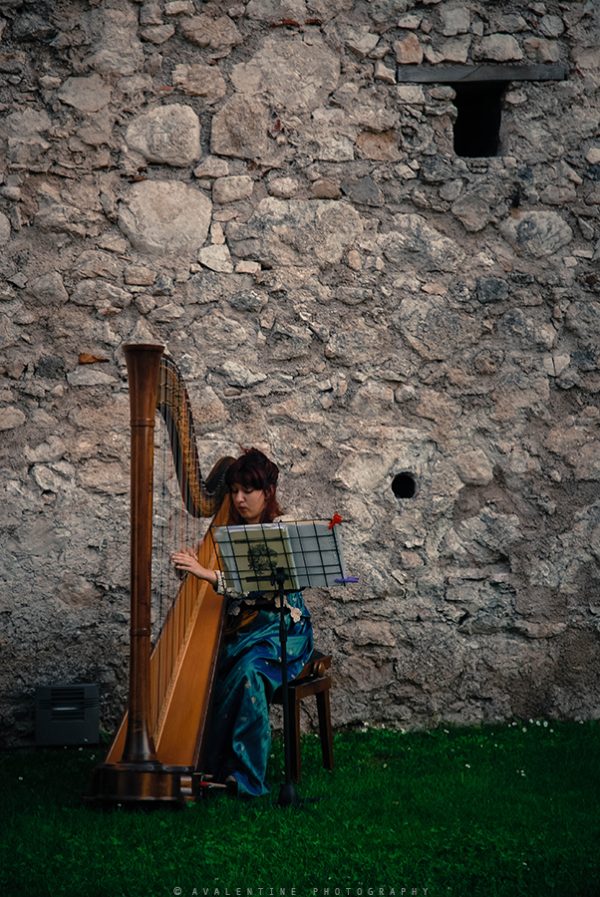
Photo by aValentine
Being part of Ravenscroft has given me a chance to enter into discussions with fellow musicians about topics most people find obscure: the merits of one time signature over another, methods of motivating six year olds to practice, and the joys of performing in below-freezing temperatures.
I discovered that I’m not the only one who speaks to musical instruments as if they were people. The other day in the recording studio Erin (our cellist) moved Chris’ guitar over so she could sit on the couch next to me.
“You good?” she asked. I looked up and then realized she was speaking to the guitar. Kathleen later volunteered that she speaks to instruments like they are small children, and Chris opted for thinking of them more like pets.
Where I’ve not gone before
Has being part of a group brought me a sense of belonging? Of knowing myself like I’ve never known myself before? Well, no. That being said, this most excellent music group is truly a joy and a challenge for me. Chris hands me a four-part arrangement of a Renaissance piece: it’s my job to make an interesting harp part. An interesting harp part that’s different from the harp part for the last piece we worked on. Oh, and then it all needs to be memorized for the Renaissance Festival. And what to do about the routine accidentals in these parts? But I don’t have to figure it out all by myself. I love the feedback in a group, where I can simply play it two different ways and my group members will say, “Definitely do it this way.” Problem solved.

Photo by Kerry Peterson
I’m excited for us to continue to grow and mesh as a group. I love the music we’re playing. It is a challenge for me to actually sing solo in front of people. One last thing: I’m delighted to announce that our first album of Renaissance music, “Faireborne: Old tunes for new ears,” will be released with a free concert of Renaissance music on Friday, September 23rd from 7:30-8:30pm at the Como Lakeside Pavilion. Our CD will include pieces by Sermisy, Ravenscroft (of course), Praetorious, and Morley, and will also be available for purchase at the MN Renaissance Festival and from me in person.
To be notified of upcoming events, like us on Facebook!
Feature photo by John Bowden
You might enjoy reading Harp in the Fantasy Novel, Part 1.
2 comments
Tom Claussen
I enjoyed your performances and can see that you guys do too. On vocals, you all do great but it did not click until I read this that I had not heard you sing before!.You have a beautiful voice, good that you now have a venue to open up and let it ring!
Three Reasons NOT to Become a Professional Harpist |
[…] Read more: Ravenscroft Musicke Guild. […]